The North American apple industry has weathered some serious challenges since my wife, Louisa, and I founded Okanagan Specialty Fruits 30 years ago. Looking ahead, I predict this sector will continue to experience dwindling profits, rising production costs and more closures, especially among smaller growers—unless we radically and fundamentally alter our operations.
Despite that gloomy forecast, I remain optimistic because I know our industry has the tools and tenacity to effect the necessary changes. I’ve articulated my own vision—and the steps for implementing it—in an “Orchard of the Future” white paper. It outlines how we can leverage agricultural biotechnology and orchard tech to reduce labor costs, enhance sustainability, address climate impacts and strengthen the bottom line.
For starters, I propose using advanced genome editing tools to make foundational changes in apple tree architecture. This paves the way for fully mechanized harvesting and improved orchard operations through robotics and artificial intelligence—our main hope for reducing ever-expanding labor costs. I project these changes could achieve savings of $8,000 to $10,000 per acre over 2025 production costs of $14,000 to $16,000 per acre through reduced expenditures on pruning, thinning, agchem, tree training, trellis construction, water and labor.
We also can alter the apple’s genome so that trees bear flowers and fruit on new growth that develops after breaking dormancy each spring, rather than on second- or third-year wood. By activating genes that influence the strength of the wood, the trees will adopt an upright or willowy habit that can be trained onto a single horizontal cordon wire. This simple trellis system is much easier and cheaper to construct and creates a truly pedestrian orchard. We can also concentrate the fruit zone in one elevation for an affordable robotic harvest.
In the meantime, technology has plenty of applications in today’s orchards. We were early adopters of orchard technology—a decision that helped us realize massive operational savings with a small investment of money and time. Last year, my son, Joel, transitioned us to a data-driven management approach that included high-definition soil mapping, tree mapping and crop load management utilizing an orchard vision system. Digital phenotyping accurately measured bud counts, bloom density, fruit set, canopy volume and disease indicators at the individual tree level using ground-mounted LiDAR and high-resolution imaging.
With these systems, our pruning costs dropped from $1,475/acre to just $114/acre using a combination of mechanical hedging and limited hand pruning, reducing our overall budget by $1 million. Thinning costs decreased from $1,565/acre to $83/acre, totaling well over another $1 million in savings. We also cut our 30% margin of error in manual fruit counting to just 10–15%, all with minimal investment and effort.
Pursuing further labor savings, we leased three autonomous tractors that saved us $8,000 in labor and $8,000 in capital per month—just on mowing. We also brought in John Deere Smart Apply technology that enabled us to reduce pesticide use by 50%, saving approximately $330/acre on insecticides and $85/acre on foliar nutrients. The results were so positive that we’re leasing more tractors this year and giving them additional tasks.
Besides saving money, this technology helped us achieve mission-central sustainability goals, which we’re furthering through various tech-based approaches to build stronger, healthier soil and trees, as well as an on-site composting program that utilizes orchard and local dairy waste. Again, this approach is saving us money and shrinking our environmental footprint.
The fruit tree industry in general also needs to improve its product with an eye toward resilience and viability. In this rapidly changing economy and climate, growing a bigger, prettier piece of fruit is no longer enough.
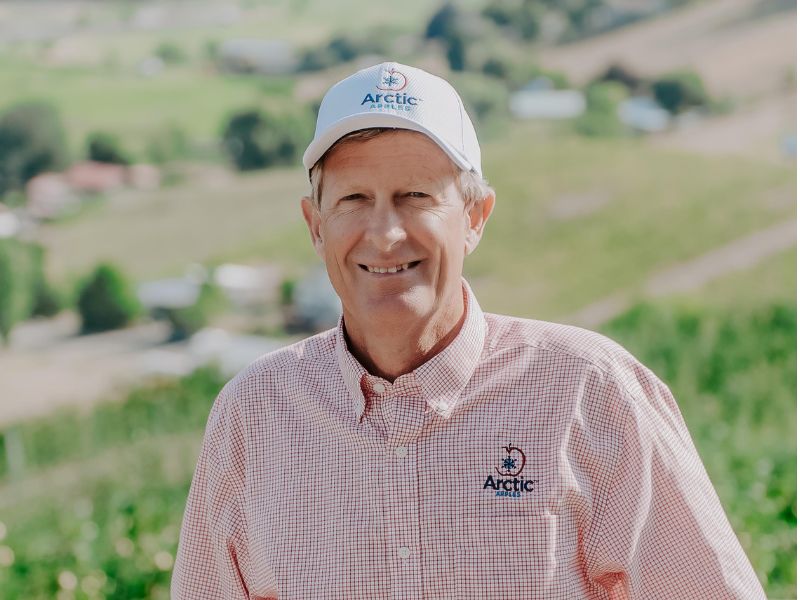
We leveraged biotechnology to create the nonbrowning Arctic® apple, which revolutionized the fresh-cut sector and allowed us to penetrate new market channels. Our scientists are now using genome editing to develop Arctic apples resistant to certain pests, diseases and environmental factors, as well as other nonbrowning varieties. Meanwhile, we’re partnering with innovators across the globe to share ideas and research applicable to other crops, with an eye to revitalize the fresh produce sector.
I’ve been an outlier and a pioneer throughout my many decades in global agriculture, and I see innovation as critical to success. I urge others in the industry to be bold, seek new solutions and try something different. Genetics and technology aren’t in themselves a silver bullet, but given current conditions in the tree fruit industry, I’d say they’re our best bet.