As food demand rises, indoor vertical farms offer promise, innovation, and tough lessons
Arlington, Virginia, United States, 27 January 2026 – By 2050, the world will need to produce nearly 60 percent more food to feed a global population expected to cross nine billion, according to the Food and Agriculture Organization of the United Nations. Meeting that challenge is pushing farmers, researchers, and entrepreneurs to rethink how and where food is grown. One solution gaining attention is vertical farming, an approach that grows crops indoors in stacked layers rather than traditional open fields.
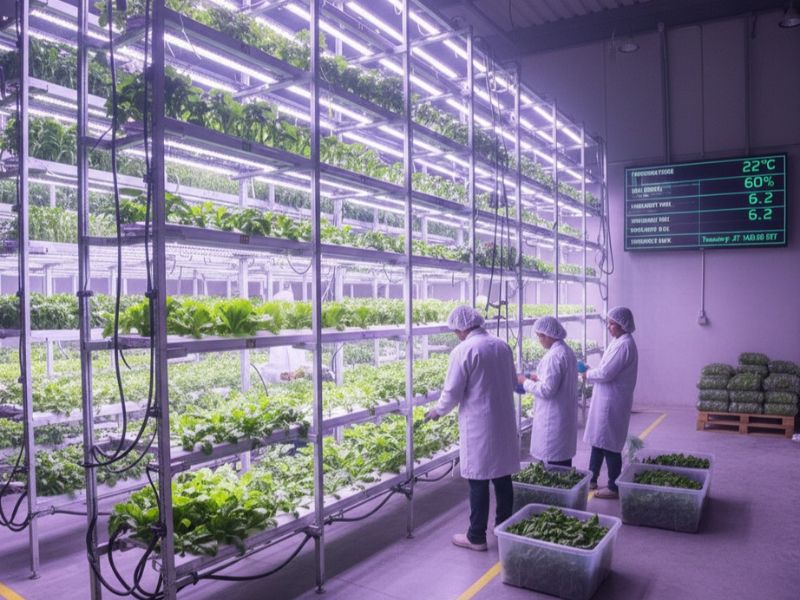
In Arlington, Virginia, an old brick warehouse has been transformed into a modern indoor farm. Inside Area 2 Farms, shelves stretch from floor to ceiling, filled with leafy greens and herbs grown in a carefully controlled environment. Instead of soil and sunlight, plants rely on nutrient-rich water, artificial lighting, and precise climate control.
The farm grows more than 180 varieties of plants and sells its produce directly to nearby customers through a weekly delivery service. The goal is simple: shorten the distance between where food is grown and where it is eaten. Many foods in the U.S. travel thousands of miles before reaching consumers, which affects freshness, cost, and sustainability.
Vertical farming falls under a broader system known as controlled environment agriculture. In a 2018 report, the United States Department of Agriculture noted that growing fresh vegetables closer to urban populations could help meet rising food demand while reducing transportation challenges.
Supporters of vertical farming point to several advantages. Because crops are grown indoors, farms can operate year-round, regardless of weather. Water use is significantly lower than in traditional field farming, as most systems recycle water. Pesticides are often unnecessary, and farms can be located close to cities, improving access to fresh produce.
Eric Stein of the Center of Excellence for Indoor Agriculture says the main idea is to grow more food in less space. By stacking crops vertically, farms can produce higher yields per square foot than conventional agriculture.
Despite the promise, the industry faces serious challenges. High startup costs, expensive technology, and especially energy use make profitability difficult. Lighting is one of the biggest expenses, as plants require far more light than humans do. In recent years, several large-scale vertical farming companies have struggled financially.
One example is Plenty Unlimited, which filed for Chapter 11 bankruptcy in 2025, despite major investments in advanced indoor farming facilities. Industry experts say some companies expanded too quickly and relied on unrealistic financial expectations.
At Area 2 Farms, innovation is key to survival. The farm uses a conveyor belt system that moves plants through different levels, reducing the need for constant lighting on every layer. By leaving the lowest levels unlit and using natural heat movement inside the building, the farm has cut lighting energy use by about 25 percent.
Researchers are also working to improve the long-term outlook for vertical farming. At Purdue University, horticulture professor Cary Mitchell is part of a federally funded project focused on optimizing indoor agriculture. The research looks at lighting, plant biology, and economics together, aiming to increase crop yields while lowering costs.
Experts agree that success in vertical farming often starts with small, carefully planned operations. Many early failures, they say, came from building facilities that were too large, too fast. Smaller teams and manageable spaces allow farms to test systems, control costs, and adapt more easily.
Vertical farms have also been considered as a way to reuse vacant commercial buildings in cities, especially after remote work left many offices empty. While warehouses can work well, experts caution that converting large office towers can be too expensive to make financial sense.
Vertical farming is not a quick fix for global food insecurity, but it continues to evolve. With steady research, realistic growth, and smarter energy use, indoor farms may become an important part of a more resilient and local food system.