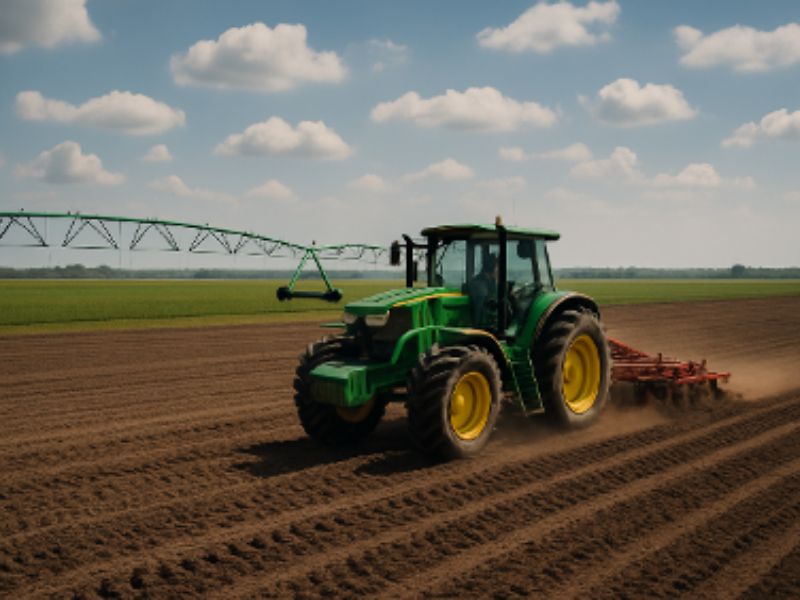
Despite weak commodity prices, technology-driven innovation and rising global food needs are expected to support steady growth in agricultural machinery.
Chicago, USA, 25 November 2025 –The U.S. farm equipment industry is experiencing a mixed outlook as falling crop revenues and volatile commodity markets weigh on short-term performance. However, rising global food demand, expanding farm sizes, and growing adoption of advanced agricultural technologies continue to support long-term opportunities for manufacturers.
The latest analysis of the Zacks Manufacturing – Farm Equipment industry shows that while the near-term landscape remains challenging, key players such as AGCO, Lindsay, Deere & Company, and CNH Industrial are strengthening their market positions through innovation, cost efficiency, and smart-farming investments.
Industry Overview
The farm equipment industry includes manufacturers of tractors, combines, harvesters, tillage and seeding machinery, nutrient application equipment, forage tools, irrigation systems, and turf-care products. Global leaders such as Deere, Kubota, and CNH Industrial continue to dominate with broad product portfolios and strong distribution networks.
The sector is increasingly shaped by technological advancements, automation, precision agriculture, and the push toward sustainable, efficient farming operations.
Market Pressures from Low Commodity Prices
The U.S. Department of Agriculture estimates net farm income will reach $179.8 billion in 2025, a strong year-over-year increase but largely driven by government support payments rather than stronger crop sales.
While livestock and animal product revenues are expected to rise, crop receipts remain under pressure due to lower prices for soybeans, corn, and wheat. At the same time, production costs, including fuel, materials, and labor, are expected to rise, adding strain to farmers’ budgets.
This imbalance remains a hurdle for farmers looking to invest in new machinery, making equipment purchases more selective and need-based.
Long-Term Demand Supported by Food Needs and Mechanization
Despite short-term challenges, the long-run fundamentals remain positive. Rising global population, shifts in diet, and increasing urbanization are driving up food demand. As farm sizes grow, machinery becomes essential to replace manual labor and meet production targets.
In many regions, government subsidies and incentive programs are helping small and mid-sized farmers invest in modern equipment. Mechanization remains a priority for countries working to boost food security and improve productivity.
Pricing Strategies and Cost Control Strengthen Margins
Farm equipment manufacturers have faced rising logistics, material, and labor costs, along with supply-chain delays. Recently, however, many companies have reported improving conditions, enabling stronger delivery schedules and lower bottlenecks.
Proactive pricing strategies, ongoing cost-reduction programs, and improved supply chain planning are helping companies support margins despite market fluctuations.
Precision Agriculture Leads the Future
Smart farming technologies, automation, GPS-guided machinery, sensors, telematics, and machine learning are becoming vital tools for modern farmers.
Manufacturers are investing heavily in solutions that increase crop yields, reduce fertilizer and fuel use, and support sustainable farming practices. Integrated systems and real-time data analytics are among the top priorities for both farmers and manufacturers.
Industry Rank Signals Short-Term Challenges
The Zacks Manufacturing Farm Equipment industry carries a rank of #220 out of 243, placing it in the bottom 9%. This indicates a subdued near-term growth outlook. Historically, industries in the bottom half underperform those in the top half by a ratio of more than 2-to-1.
Despite this, several companies remain well-positioned for long-term gains.
AGCO Corporation
AGCO continues to benefit from strong replacement demand as farmers trade in older machinery. The company is investing heavily in precision farming technologies and digital capabilities.
AGCO recently finalized a major agricultural technology partnership to expand its Precision Planting business under the new PTx platform, giving it a leading position in precision agriculture tools for mixed fleets.
With a long-term earnings growth rate of 12.6% and a consistent track record of earnings surprises, AGCO remains a solid performer with strategic momentum.
Lindsay Corporation
Lindsay posted strong results in fiscal 2025, supported by growing irrigation demand and infrastructure project success. Its recent investment in Pessl Instruments is expected to accelerate water-management innovation and expand global reach.
The company’s Road Zipper System, known for its cost-efficient lane construction and mobility, continues to gain global traction.
With strong balance-sheet discipline and growing international irrigation opportunities, Lindsay is well-positioned for the future.