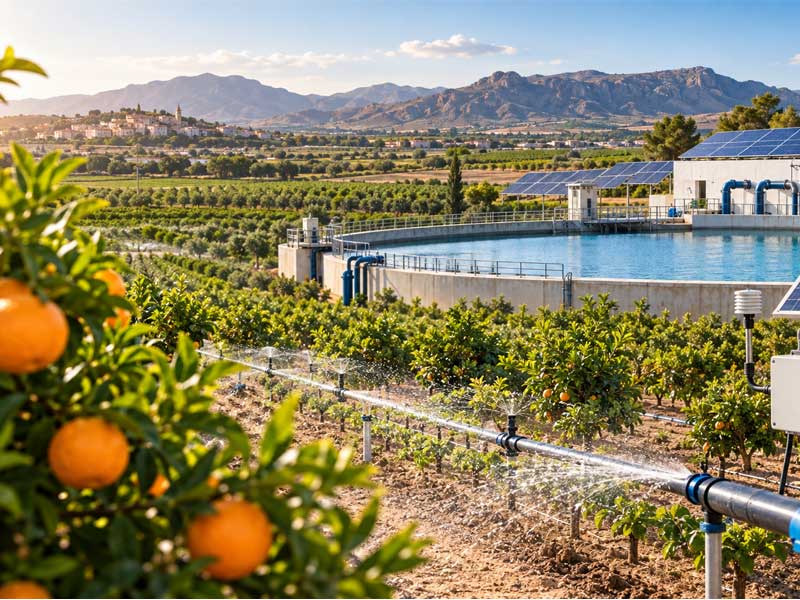
A more than €22 million modernization project is bringing digital irrigation, renewable energy and better water management to thousands of agricultural users in southeastern Spain
Librilla, Murcia, 9 September 2026 – Agriculture in Librilla, a municipality in Spain’s Murcia region, is entering a new phase as its irrigation infrastructure receives a major technology upgrade. More than €22 million has been invested in modernizing the area’s irrigation systems, with the project expected to benefit around 2,200 members of the local irrigation community.
The modernization is particularly important for Librilla, where citrus farming plays a major role in agricultural activity. The improvements are designed to help farmers use water and energy more efficiently while giving them access to more modern tools for managing their farms.
The project is divided into two main initiatives. One received approximately €20.5 million in investment, while a second project, known as Librilla II, received around €1.5 million. Together, the projects represent an investment of more than €22 million in the region’s irrigation infrastructure.
One of the biggest changes is the introduction of pressurized irrigation systems. In simple terms, this means water can be delivered to agricultural fields through a controlled network rather than relying on older and less efficient methods. Better control can help farmers manage water more precisely and reduce unnecessary use.
The modernization also includes new water storage facilities, filtration systems, pumping equipment, updated irrigation networks, and digital controls. These technologies can make it easier to monitor and manage irrigation operations while improving the reliability of water delivery.
Another important part of the project is the use of renewable energy. Solar power infrastructure has been incorporated into the irrigation system, helping provide cleaner energy for pumping and other operations. A photovoltaic installation has also been integrated with one of the project’s reservoirs.
Water reuse is another key element. The upgraded system is designed to make greater use of non-conventional water sources, including treated wastewater. This approach can provide agriculture with an additional water resource while supporting more efficient use of existing supplies.
The project also reflects the growing role of digital agriculture. Automated systems and remote controls can give irrigation communities greater control over when and how water is delivered. For farmers, this can mean less manual work and better decision-making based on available water and operational conditions.
The modernization covers more than infrastructure alone. It is also intended to support the long-term future of farming in Librilla by making agricultural operations more efficient and technologically advanced. With younger farmers increasingly looking for modern tools and sustainable production methods, smarter irrigation could play an important role in keeping agricultural businesses competitive.
Librilla is part of a wider modernization effort across the Murcia region. According to Spain’s Ministry of Agriculture, nine irrigation modernization projects in the region have received more than €68 million in investment. These projects focus on improving water efficiency, energy efficiency, environmental performance and digitalization.
The wider investment highlights how irrigation technology is becoming an increasingly important part of modern agriculture. As farmers face pressure to produce more efficiently and manage limited resources carefully, technologies such as smart irrigation, renewable energy, water recycling and digital monitoring are gaining importance.
For Librilla’s farming community, the €22 million transformation represents more than an infrastructure upgrade. It is a move toward a more connected and resource-efficient agricultural system, where water, energy and technology work together to support farming for the years ahead.