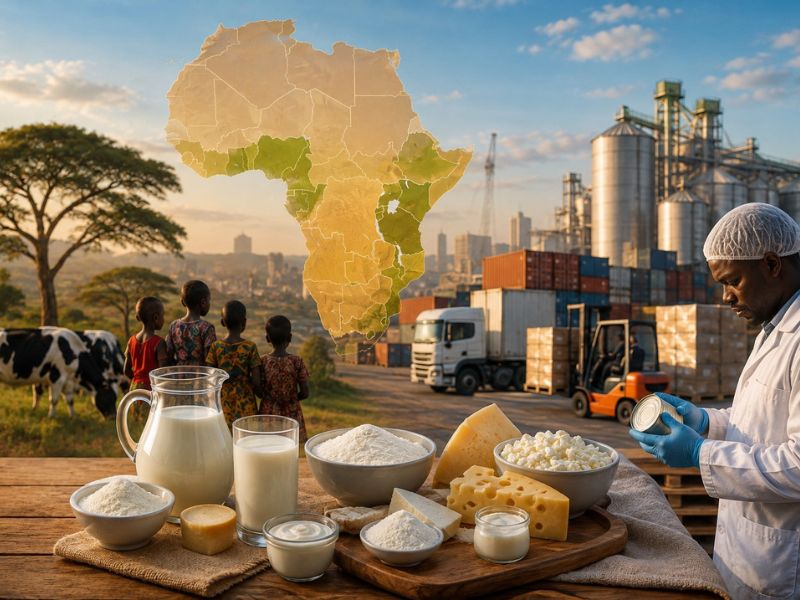
The U.S. dairy industry is exploring new opportunities across Sub-Saharan Africa through market research, local partnerships, and a long-term export strategy.
Arlington, Virginia, August 12, 2026 – The global dairy industry is exploring new markets as companies look beyond their traditional customers. Sub-Saharan Africa is gaining attention as an emerging opportunity, with the U.S. dairy industry working to strengthen its presence across the region.
The U.S. Dairy Export Council has identified Sub-Saharan Africa as a promising long-term market for American dairy products and ingredients. Its strategy for 2026 to 2030 focuses on opportunities across West, East, and Central Africa while examining local demand, consumer preferences, business conditions, and routes to market.
The opportunity spans several countries, each with different consumer needs, food industries, distribution networks, and dairy requirements. Rather than applying one approach across the region, exporters are studying individual markets to understand where their products can create the most value.
Population growth and changing food preferences are creating new possibilities for dairy companies. The U.S. Dairy Export Council has developed market research covering countries such as Kenya, Senegal, Ghana, Nigeria, and Angola. These studies are helping businesses identify potential opportunities while understanding the challenges involved in entering new markets.
West Africa is an important area of focus. In 2026, the council’s ingredients marketing team visited Senegal to explore opportunities and meet food and beverage processors, distributors, and importers. Ghana and Côte d’Ivoire are among the key markets being examined, while Nigeria and Mauritania are also receiving attention.
The opportunity extends beyond traditional dairy products. Ingredients such as milk powders, whey, cheese ingredients, lactose, and other specialized dairy products can support food and beverage manufacturing. They can be used in beverages, yogurt, bakery products, snacks, nutrition products, and processed foods.
Earlier research by the council identified products such as skim milk powder, whey, cheese, lactose, whole milk powder, infant formula, and condensed or evaporated milk as having export potential in several Sub-Saharan African markets.
Expanding into the region requires more than shipping products overseas. Exporters need to understand local pricing, consumer preferences, regulations, distribution systems, food manufacturing capabilities, and supply chain conditions. Local partnerships with processors, distributors, importers, and other businesses can help companies understand these markets and establish stronger supply networks.
Dairy products and ingredients can also support the wider food and nutrition sector. For manufacturers, dairy ingredients provide protein, taste, functionality, and nutritional value, creating opportunities for both dairy exports and value-added food production.
The growing interest in Sub-Saharan Africa reflects a broader shift in the global dairy industry. Exporters are increasingly exploring markets where population growth, food manufacturing, and changing consumer demand could support long-term expansion.
For U.S. dairy companies, success will depend on market knowledge, reliable supply chains, product development, and strong local relationships. The council’s research and market visits indicate that the industry is moving from simply identifying opportunities toward building practical connections in the region.
As these efforts continue, Sub-Saharan Africa could become an increasingly important destination for U.S. dairy exports. For the American dairy industry, the region represents an opportunity to diversify its global markets and build long-term growth through partnerships and deeper market understanding.