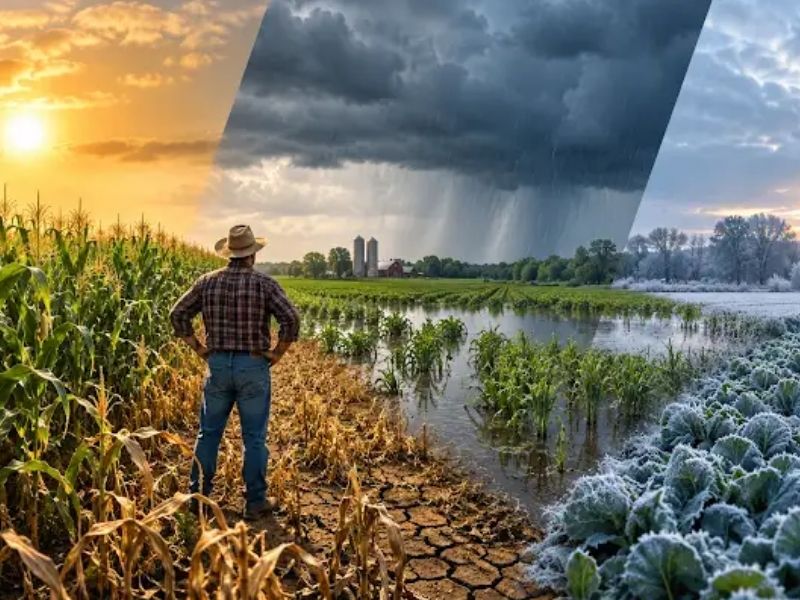
Unpredictable weather is creating different challenges across farming regions as growers work to protect crops and keep harvest operations moving
Washington, D.C., 16 September 2026 – Weather is once again becoming a major factor in the U.S. agricultural season. Farmers across different regions are facing a mix of extreme heat, heavy rainfall, flooding, dry conditions, and the possibility of early frost. Because these conditions are not affecting every region in the same way, growers are adjusting fieldwork, crop protection, and harvest plans according to local conditions.
The latest weather outlook shows a sharp contrast across the country. Parts of the Northeast are expected to experience cooler conditions that could bring the first frost and freeze of the season to some areas. At the same time, portions of the western and central United States face the possibility of heavy rainfall and flooding. The National Weather Service has also identified potential heavy precipitation across the Four Corners region and parts of Alaska.
For farmers, timing is especially important during the harvest season. Crops that are close to maturity need suitable weather conditions for harvesting, drying, transportation, and storage. Rain can make fields too wet for machinery, while excessive heat can accelerate crop development and reduce the time available for certain harvesting activities.
The impact of hot weather can already be seen in several agricultural regions. In Arkansas, dry conditions and high temperatures helped speed up the harvest of corn, rice, and soybeans earlier in September. More than half of the state’s corn crop had been harvested, while the rice harvest had also moved forward quickly. The heat was also pushing cotton closer to harvest.
However, faster crop development does not always mean easier farming. Extremely hot and dry conditions can increase water demand, affect crop quality, create difficult working conditions, and increase the pressure on farm equipment and labor. Harvesting during periods of intense heat can also require careful planning to protect workers and maintain equipment performance.
In Iowa, the picture is more mixed. Farmers have been preparing for corn and soybean harvest while waiting for crops to mature and dry down. Recent rainfall helped improve soil moisture in some areas that had experienced longer-term deficits. However, corn maturity remained behind the previous year, showing how weather conditions earlier in the growing season can continue to influence harvest timing.
The Midwest also experienced significant heat at the beginning of September. Weather officials reported that September 1 through 4 was the hottest four-day start to September on record for Chicago and Rockford. High heat indices reached between 100 and 110 degrees Fahrenheit across much of northern Illinois and northwestern Indiana during the period. Heavy thunderstorms also created the possibility of localized flash flooding in parts of the central Plains and Desert Southwest.
While heat is affecting some farming areas, frost is becoming a concern farther north. The National Weather Service expects a cooler air mass to move into parts of the Northeast, with some areas potentially experiencing temperatures below 40 degrees Fahrenheit. Although early frost is not unusual in some northern regions during late September, freezing temperatures can still affect sensitive vegetation and crops that have not completed their growing cycle.
Excessive rainfall creates another set of problems. Saturated fields can delay machinery operations, interfere with harvesting, increase disease pressure, and make it harder for farmers to access fields. Earlier in the 2026 growing season, excessive rainfall in parts of the Midwest contributed to planting delays, weed management problems, and drowned-out areas.
Flooding can also affect agricultural infrastructure beyond the fields. Roads, drainage systems, irrigation equipment, storage facilities, and transportation routes can all be affected when heavy rainfall arrives in a short period. For growers, this means that weather planning involves much more than watching temperature forecasts.
The current conditions highlight the importance of accurate weather information in modern farming. Farmers increasingly rely on forecasts, soil moisture information, crop monitoring, irrigation planning tools, and other digital agriculture technologies to make decisions about when to plant, irrigate, spray, harvest, and move equipment.
Weather variability also makes regional planning more important. A farmer in the Northeast may be watching frost forecasts while a grower in the Southwest is preparing for heavy rainfall. In the central United States, producers may instead be balancing heat stress and dry conditions with the need to complete harvest operations.
Despite these challenges, farmers continue to adapt their schedules and management practices to changing field conditions. The ability to respond quickly can help reduce weather-related losses and keep agricultural operations moving.
As the U.S. enters a critical part of the 2026 harvest season, weather will remain closely connected to crop progress, farm productivity, and supply chain activity. Frost, flooding, heat, and rainfall may affect different regions in different ways, but together they demonstrate how closely modern agriculture depends on timely weather information and flexible farm management.